1. Executive Summary
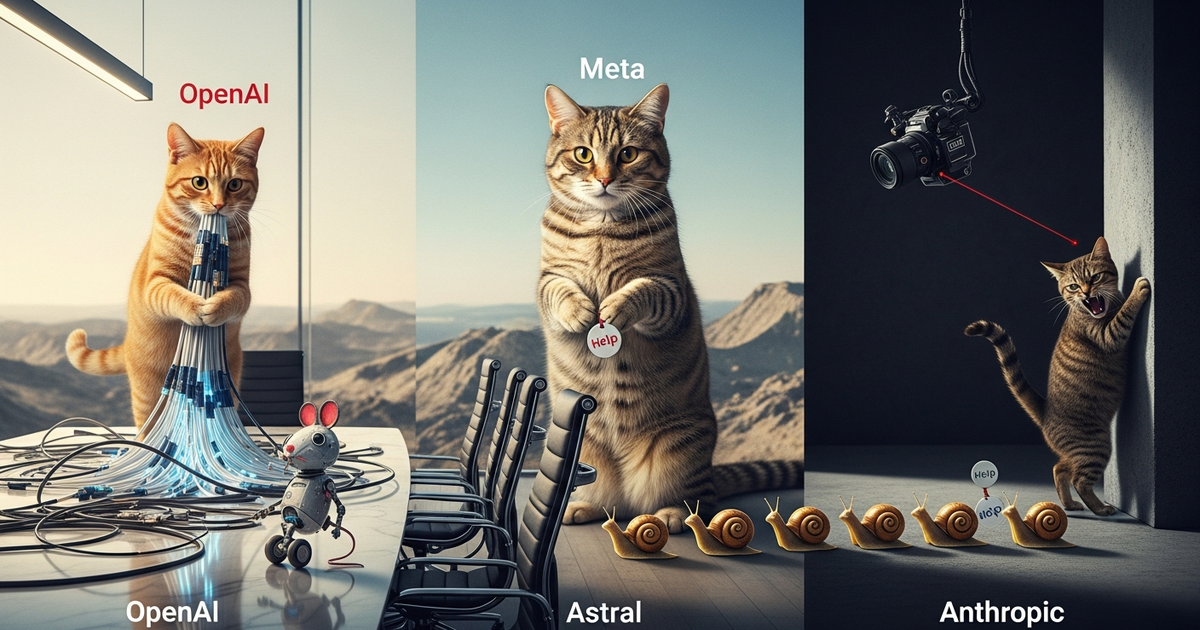
Today, acquisitions by AI companies aimed at vertical integration of development ecosystems are accelerating. OpenAI acquired Python development tool company Astral, strengthening its foundation for developers. Meanwhile, Meta is globally deploying AI-driven support functions to automate user experiences. In contrast, the conflict between Anthropic and the US Department of Defense continues, surfacing practical disruptions in on-the-ground AI utilization.
2. Today’s Highlights
OpenAI Acquires Python Tool Company Astral, Strengthening Developer Ecosystem
On March 19, OpenAI announced its agreement to acquire Astral, an open-source development tool company highly regarded in the Python community. This acquisition is seen as a symbolic move for OpenAI transitioning from a research-driven lab to a vertically integrated software powerhouse. Astral provides exceptionally fast and reliable tools for Python package management and code analysis. By integrating these technologies into OpenAI’s “Codex” platform, the aim is to further advance the automation of software development processes. According to OpenAI’s announcement, Codex’s weekly active users have surpassed 2 million, a threefold increase since the beginning of the year. With this integration, they aim to build the most productive development environment for engineers. The Astral team will join OpenAI, and support for existing open-source projects is expected to continue.
Meta Rolls Out AI-Powered Support Features Globally to Facebook and Instagram
On March 19, Meta announced the global rollout of AI-powered support assistants within the Facebook and Instagram apps. This assistant is designed to resolve everyday account management issues, such as password updates and profile settings, 24/7. According to Meta’s blog, many users receive answers within five seconds, dramatically reducing wait times compared to traditional help center searches. Furthermore, this AI system is being utilized in security domains, including detecting fraud, impersonation, and inappropriate content. Initial testing successfully improved the detection accuracy of sexual solicitation content while reducing false positive rates by 60%. This is part of Meta’s strategy to complement human moderation and achieve rapid and secure community management through automation.
Anthropic and US Department of Defense Tension Leads to “AI Usage Stagnation” on the Ground
Disruption continues surrounding the US Department of Defense’s designation of Anthropic as a “supply chain risk.” According to reports on March 19, the Pentagon has ordered the termination of Anthropic product use within the military within six months, but significant pushback is occurring among on-the-ground IT personnel and contractors. Particularly, development support tools like Claude Code have become de facto standards for military data analysis and workflow construction. Testimonies suggest that a rapid transition to alternative tools is leading to a drastic decline in development efficiency. Anthropic has filed a lawsuit in federal court, arguing this designation is unwarranted. Some military officials are engaging in “slow-rolling” – intentionally delaying migration work – in anticipation of a legal resolution or reconsideration.
3. Community Hot Topics
Intensifying Competition in AI Coding and User Confusion
On platforms like Reddit’s r/LocalLLaMA, discussions are active regarding which tools should be standardized as major AI companies rapidly enhance their coding functionalities. Specifically, OpenAI’s acquisition of Astral and the stringent political pressure on Anthropic are creating uncertainty in selecting development environments. Engineers are posting experiences such as, “The cost of setting up AI agents and rebuilding workflows is a more serious problem than switching models,” with growing concerns about the risks of dependency on specific platforms.
”AI Brain Fry” – The Pitfalls of Over-Reliance on AI Become a Topic of Discussion
On X (formerly Twitter), a discussion is gaining momentum, referring to the phenomenon of reduced deep thinking abilities due to over-reliance on AI as “AI Brain Fry.” Particularly, voices from the field are sharing concerns about the deterioration of reasoning skills, which are fundamental to problem-solving, in environments where complex logic design and debugging are outsourced to AI. Some senior engineers are sounding a warning that AI should remain merely an “efficiency tool” and that the responsibility for design should not be abandoned.
4. Other News
- Google Enhances Gemini API Tool Integration: Google DeepMind has implemented a feature allowing sequential calls to multiple tools (e.g., Search, Google Maps) in a single request. The technology, called “context circulation,” enables automatic passing of previous processing results to the next tool, allowing developers to build more complex agent workflows. Google DeepMind Official Blog
- Cognitive Framework for AGI Measurement Released: Google DeepMind has proposed a “cognitive taxonomy” to evaluate how close AI systems are to AGI (Artificial General Intelligence) from a cognitive science perspective. They have also launched a Kaggle hackathon to build evaluations based on this framework. Google DeepMind Official Blog
- Anthropic Surveys 80,000 Users on AI Needs: Anthropic has released a report based on a survey of approximately 81,000 Claude users regarding their expectations and fears about AI. This is a comprehensive qualitative study reflecting the multilingual and diverse needs of users. Anthropic Official Blog
- OpenAI Updates Monitoring for Internal Coding Agents: OpenAI has released new monitoring processes on GitHub and elsewhere for detecting model misalignment risks. They are particularly focused on ensuring safety in agents that perform autonomous coding. OpenAI Official Blog
5. Conclusion and Outlook
Looking at the news as a whole today, the AI industry is rapidly shifting from a phase of “experimentation and exploration” to “production and integration into industry.” Companies are incorporating AI not merely as chatbots but as indispensable agents in development processes and support operations. Within this, technical challenges of “how to achieve efficiency” intersect with geopolitical and regulatory challenges of “how to ensure security and reliability.” In the future, as excessive reliance on specific platforms becomes a risk, demand for multi-model environments and portable AI workflows is expected to increase further.
6. References
| Title | Source | Date | URL |
|---|---|---|---|
| How we monitor internal coding agents | OpenAI Blog | 2026-03-19 | https://openai.com/news/how-we-monitor-internal-coding-agents-for-misalignment/ |
| OpenAI to acquire Astral | OpenAI Blog | 2026-03-19 | https://openai.com/news/openai-to-acquire-astral/ |
| Boosting your support and safety | Meta Newsroom | 2026-03-19 | https://about.fb.com/news/2026/03/boosting-your-support-and-safety-on-metas-apps-with-ai/ |
| What 81,000 people want from AI | Anthropic News | 2026-03-18 | https://www.anthropic.com/news/what-81000-people-want-from-ai |
| Measuring progress towards AGI | Google DeepMind | 2026-03-17 | https://deepmind.google/discover/blog/measuring-progress-towards-agi-a-cognitive-framework/ |
| Gemini API updates 2026 | Google Blog | 2026-03-18 | https://blog.google/technology/ai/google-deepmind-gemini-api-updates-2026/ |
This article was automatically generated by LLM. It may contain errors.