Executive Summary
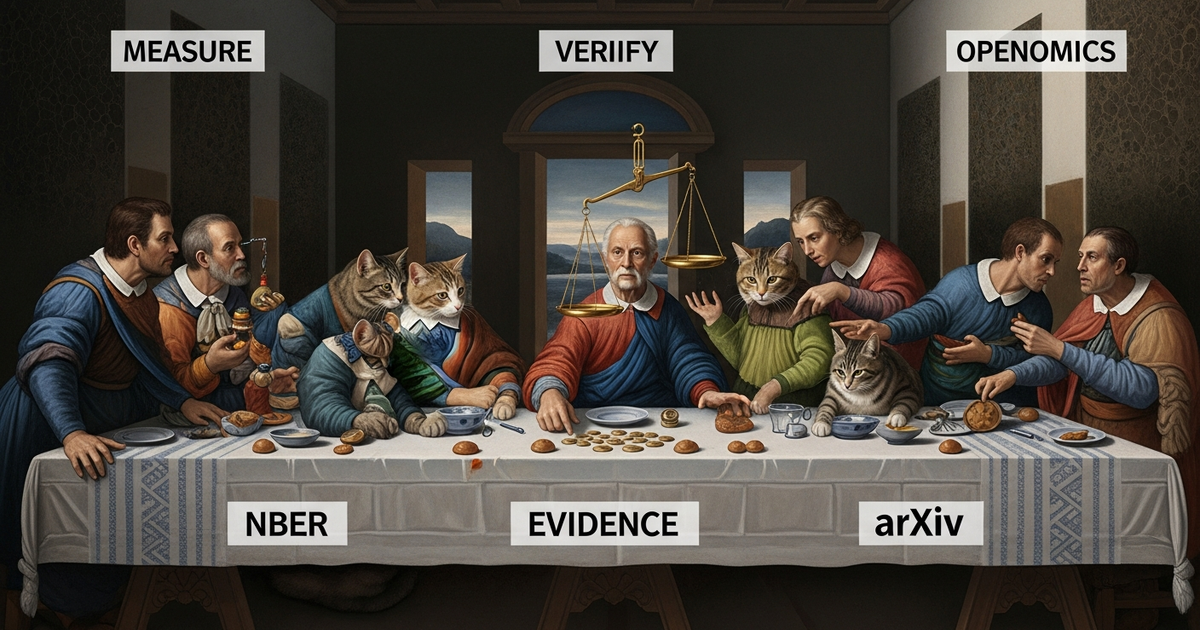
In the last 24 hours of observations, interest on the “implementation and verification” side has been strong—specifically, “how to measure AI outcomes” and “how to operate AI safely in the field.” In the economics domain, NBER is leading with methodologies for measuring AI’s impact economically, while in healthcare WHO is covering the operational work of using AI in cholera response. Further, on arXiv, research has emerged aiming at neural networks that are “verifiable” in domains where task identification is clear. Today’s cross-domain trend is moving toward not only performance, but simultaneously working through explainability, governance, and operational design.
Robotics / Autonomous Agents
- Under the most recent 24-hour conditions, we were unable to secure the number of identifiable items for the “news / announcement” slot relevant to the domain from primary sources (official releases from universities, companies, government, or international organizations, or the latest arXiv submissions).
- Therefore, we will not cover the robotics domain in the main text and will instead focus on descriptions based on primary sources from other domains (Note: this decision follows the policy of adopting only those where the existence of the primary-source URLs could be confirmed).
Psychology / Cognitive Science
- Under the most recent 24-hour conditions, we were unable to confirm the latest 24-hour “announcements” in the psychology / cognitive science domain from primary sources (university and academic institution press releases, official blogs, latest arXiv submissions, etc.).
- Therefore, we will not set up a news slot for the domain, and will instead produce a digest centered on domains where primary sources related to measurement, verification, and operations could be confirmed (economics, healthcare AI, verifiable AI).
Economics / Behavioral Economics
- NBER (National Bureau of Economic Research, US) explicitly stated that it will hold a meeting on May 7, 2026 on “economic measurement” aimed at quantifying AI’s impact. The meeting’s goal is to organize: how AI tools change traditional statistical production and data collection / statistical construction / policy evaluation; and how to measure AI’s effects on the economy (the adjustability of labor-market activity and productivity indicators, and what additional information new AI-derived information provides for economic activity). (nber.org)
- In addition, in NBER’s related project descriptions, it outlines a policy to treat AI and economic measurement as an ongoing theme, organizing it into three points: applying AI to traditional statistics, how to measure AI effects, and how to handle new AI information indicators. What matters here is that the focus is not merely on a research forum, but on “updating the measurement mechanisms.” As AI adoption increases, the observability of labor, production, and market activity changes, and the interpretation of conventional indicators may also become unstable—so methodological updates will become a prerequisite for policy and corporate decisions. (nber.org)
- A notable implication that has drawn attention recently is that, even from a behavioral-economics perspective, when measuring “how AI affects human decision-making,” the bottleneck often ends up being “what we adopt as proxy variables for outcomes, actions, and preferences.” How far AI-generated data (text, search behavior, operational logs, etc.) can be brought into official statistics and policy evaluation frameworks—and how to handle measurement error and sample bias—emerges as a connection point between research and institutions.
(Source: NBER: AI and Economic Measurement, Spring 2026 / NBER: AI & Economic Measurement (project/center description))
Life Sciences / Drug Discovery AI
- Under the most recent 24-hour conditions, we were unable to secure a URL that could be identified as a “recent drug-discovery AI announcement” from primary sources in the life sciences / drug discovery AI domain (relevant papers among the latest arXiv submissions, official press releases from universities and companies, etc.).
- Therefore, for the life sciences slot, we will refrain from writing unless there is content that can be confirmed as “relevantly and certainly within the last 24 hours” via primary sources.
Educational Engineering
- Under the most recent 24-hour conditions, we were unable to verify educational engineering (EdTech, learning support, AI-enabled education) from primary sources as a “latest 24-hour announcement.”
- Therefore, we will skip the domain.
Business Administration / Organization Theory
- Under the most recent 24-hour conditions, we were unable to secure primary sources relevant to business administration / organization theory (organizational transformation for AI adoption, decision support, business strategy).
- Therefore, we will skip.
Computational Social Science
- Under the most recent 24-hour conditions, we were unable to secure primary sources from computational social science (social media analysis, misinformation detection, social simulation, etc.) that could serve as specific recent news / announcements.
- Therefore, we will skip the domain.
Financial Engineering / Computational Finance
- Under the most recent 24-hour conditions, we were unable to secure primary sources from the financial engineering / computational finance domain (government and international organization releases, company announcements, relevant items among the latest arXiv submissions, etc.) that could yield identifiable news / announcement URLs.
- Therefore, we will skip.
Energy Engineering / Climate Science
- Under the most recent 24-hour conditions, we were unable to secure primary sources from the energy engineering / climate science domain (government and international organization releases, company announcements, relevant items among the latest arXiv submissions, etc.) that could yield identifiable news / announcement URLs.
- Therefore, we will skip.
Space Engineering / Space Science
- Under the most recent 24-hour conditions, we were unable to secure primary sources from the space engineering / space science domain that could yield identifiable news / announcement URLs.
- Therefore, we will skip.
(Supplement) Primary Sources on “Operations / Governance” via Healthcare AI (Life-sciences-leaning)
WHO: AI-support for cholera response—“listening to communities” (May 6, 2026 event)
- WHO has announced a webinar for May 6, 2026 that addresses an approach to “support listening to communities with AI” as an event in the health emergency space. The context here is that cholera is a major public health threat and tends to spread especially in regions with limited access to safe water, sanitation, and healthcare.
- Specifically, it suggests that by analyzing large-scale community feedback—such as hotlines, social media, radio, surveys, and reports from the front lines—it may be possible to detect information such as early signs of an outbreak, concerns and rumors, gaps in medical services, and barriers to seeking care more quickly and in a more people-centered way. (who.int)
- The recent significance lies not so much in AI for drug discovery itself, but in clarifying AI’s position in operational processes in medical settings and public health. In outbreak response, what determines success is not only “prediction,” but also the “timing of decision-making,” “summaries in a form the field can use,” and “how to handle false-report risks.” As such, this primary source becomes supporting material for the practical issue of “turning AI into an operationally usable information pipeline.”
(Source: WHO: WHO Health Emergencies EPI-WIN webinar… (cholera))
WHO: An “AI” hub in digital health (links to policies, news, and materials)
- WHO has created an “Artificial intelligence (AI)” topic page within digital health (Digital health), aggregating links to responsible AI (especially for mental health, etc.), AI use in healthcare and research, ethical and governance guidance, related events, and more. (who.int)
- In the context of the recent digest, it can be read that individual initiatives such as the cholera response event above connect to WHO-wide responsible AI operations (guidelines and frameworks) as a whole. In domains where an exchange between research → implementation → governance is necessary, such official hub pages are practical primary information for outsiders to understand “which discussions are connected to policy and ethics.”
(Source: WHO: Digital health / Artificial intelligence)
(Supplement) A cross-cutting theme of Verifiable AI (formal guarantees) (arXiv)
Verified Neural Compressed Sensing (arXiv.04260)
- On arXiv, researchers such as those at Google DeepMind present an approach under the banner of “Verified Neural Compressed Sensing,” aiming for neural networks to be provably correct for a clearly defined computational task: compressed sensing. (arxiv.org)
- The important point is that, after clearly articulating the problem awareness that conventional neural network verification may only ensure that a portion of specifications (a partial specification) is satisfied—meaning it may not guarantee that the result is “never wrong for all inputs”—the work is trying to move toward a direction based on a stricter definition of “correctness.” (arxiv.org)
- As a cross-domain trend, this kind of research reinforces the direction of bringing the “grounds for AI reliability” in economic measurement (NBER) and operational use in public health (WHO) closer to “verification” rather than performance metrics. As AI adoption increases, measurement and operations are more likely to shift in their demands—from “estimating errors” toward “eliminating errors and proving boundary conditions.” Verifiability becomes a shared language for social implementation.
(Source: arXiv: Verified Neural Compressed Sensing)
Summary and Outlook
From the most recent 24-hour observations based on primary sources this time, we confirmed that the cross-domain core is shifting toward “measuring / verifying / operating” AI outputs in ways that can stand up to decision-making.
In economics, NBER has presented both a meeting and a project that organize AI’s effects on statistics, policy evaluation, and indicator formation as “economic measurement,” placing the discussion of how policy and corporate decision-making should be redesigned under AI diffusion at the center. (nber.org) In healthcare, WHO addresses an operational practice of analyzing community feedback for cholera response, positioning AI not as a “prediction model” but as information processing that can be used for decision-making in the field. (who.int) On the technical side, arXiv’s Verified Neural Compressed Sensing shows a direction that defines “correctness” and sets verifiability as a goal, aligning with societal deployment requirements (low tolerance for errors, and the need for justification). (arxiv.org)
The points to watch going forward are that (1) indicator design on the economic and social side for measuring AI effects, (2) information pipeline design on the ground—such as in public health and corporate operations, and (3) integrating technical guarantees (verifiability) in a way that can create accountability—advance simultaneously. As these pieces align, AI should evolve from “deploying and finishing” into “a system that continues operating.”
References
| Title | Information Source | Date | URL |
|---|---|---|---|
| AI and Economic Measurement, Spring 2026 | NBER | 2026-05-07 | https://www.nber.org/conferences/ai-and-economic-measurement-spring-2026 |
| AI & Economic Measurement | NBER | 2026-03-31 | https://www.nber.org/programs-projects/projects-and-centers/8951-ai-economic-measurement |
| WHO Health Emergencies EPI-WIN webinar: artificial intelligence (AI) supported listening to communities for cholera | WHO | 2026-05-06 | https://www.who.int/news-room/events/detail/2026/05/06/default-calendar/who-health-emergencies-epi-win-webinar-artificial-intelligence-supported-listening-to-communities-for-cholera |
| Digital health / Artificial intelligence | WHO | 2026-03-20 | https://www.who.int/health-topics/digital-health/artificial-intelligence |
| Verified Neural Compressed Sensing | arXiv | 2024-05-08 | https://arxiv.org/pdf/2405.04260 |
This article was automatically generated by LLM. It may contain errors.