1. Executive Summary
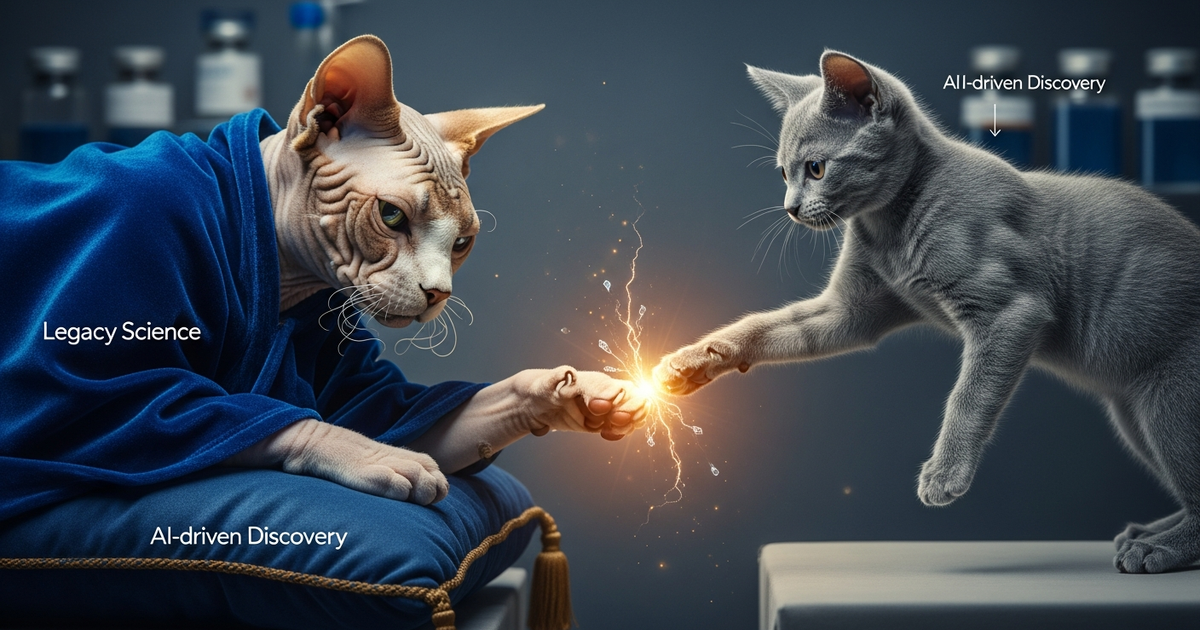
Today marked a day of further acceleration in the societal implementation of AI, both in science and business. Particularly in the drug discovery field, Amazon and Novo Nordisk announced AI-driven pipeline efficiencies, leading to a dramatic increase in R&D speed. Meanwhile, in the realms of organizational studies and psychology, it was presented that successful AI adoption hinges not just on technological application, but more fundamentally on human behavioral change and new forms of leadership.
2. News by Sector
Life Sciences & Drug Discovery AI
The field of drug discovery saw a series of major AI adoption news. Amazon Web Services (AWS) officially released “Amazon Bio Discovery.” This platform leverages biological foundation models, designed to allow researchers to execute complex computational workflows without writing code. In a joint study with Memorial Sloan Kettering Cancer Center, they succeeded in shortening antibody molecule design and refinement, a process that previously took months, to just weeks.
Novo Nordisk also announced a strategic partnership with OpenAI. This collaboration aims to apply AI across the entire value chain, not only in drug discovery but also in manufacturing, supply chain, and sales. CEO Mike Doustdar emphasized that this initiative is intended to “supercharge” scientists’ capabilities rather than replace them.
Furthermore, Labcorp, in collaboration with AWS and Datavant, unveiled an AI-powered real-world data platform to accelerate Alzheimer’s disease research. This platform enables data collection and analysis, which used to take months of manual effort, to be completed in mere minutes.
Source: Amazon Bio Discovery Announcement (Investing.com), Novo Nordisk Partnership Announcement (Invezz), Labcorp Platform Announcement (Labcorp)
Business Administration & Organizational Theory
An interesting analysis was published regarding the impact of AI adoption on management. According to Bain’s “Live the Model” survey, AI-focused organizational restructuring tends to yield less favorable outcomes compared to other types of organizational transformation. The primary reason cited was not technical barriers, but rather that leadership has failed to adequately coach employees on “how to work within the new model.” Successful AI adoption requires a strategic and human-centered transformation that considers the 20/200/2,000 leadership hierarchy (executive, middle management, front-line).
Similarly, the latest data from Gallup highlights the challenge that while AI users feel productivity improvements, cases where the organization as a whole feels “their way of working has fundamentally changed” are still limited.
Source: Bain & Company Survey Results (Bain)
Psychology & Cognitive Science
A groundbreaking study by a team led by Dr. Ashok Shetty at Texas A&M University was published in the “Journal of Extracellular Vesicles.” Research conducted on mice showed that a nasal spray that suppresses inflammation and restores memory has the potential to reverse age-related cognitive decline (neuroinflammation) in the brain. This suggests that brain aging is not an irreversible process but has aspects of treatable “chronic inflammation,” which could lead to a significant turning point in the development of future dementia treatments.
Source: Texas A&M University Announcement (Texas A&M)
Robotics & Autonomous Agents
KEENON Robotics unveiled its next-generation facility management robot fleet at Interclean Amsterdam 2026. Featuring “AI Patrol Inspection” technology, these robots can not only follow fixed routes but also detect floor soiling in real-time, autonomously switch cleaning modes, and calculate efficient routes. This represents an effort to provide more advanced and autonomous operational solutions to the facility management industry, which is grappling with labor shortages.
Source: KEENON Robotics Announcement (PR Newswire)
3. Conclusion and Outlook
Looking at today’s news collectively, a clear dichotomy emerges between “exponential enhancement of capabilities through AI technology” and “adaptation with the pain of transformation” for organizations and society to accept it. While the cases of Amazon and Novo Nordisk in drug discovery demonstrate the potential to compress decades-long challenges into weeks, organizational studies show that no matter how powerful AI is, its value cannot be maximized if the people using it cannot adapt to new processes.
Moving forward, beyond the performance improvement of technology itself, the source of competitiveness will lie in the optimization of softer aspects, such as “how humans collaborate with AI and how organizational structures should be flexibly designed.”
4. References
This article was automatically generated by LLM. It may contain errors.