1. Executive Summary
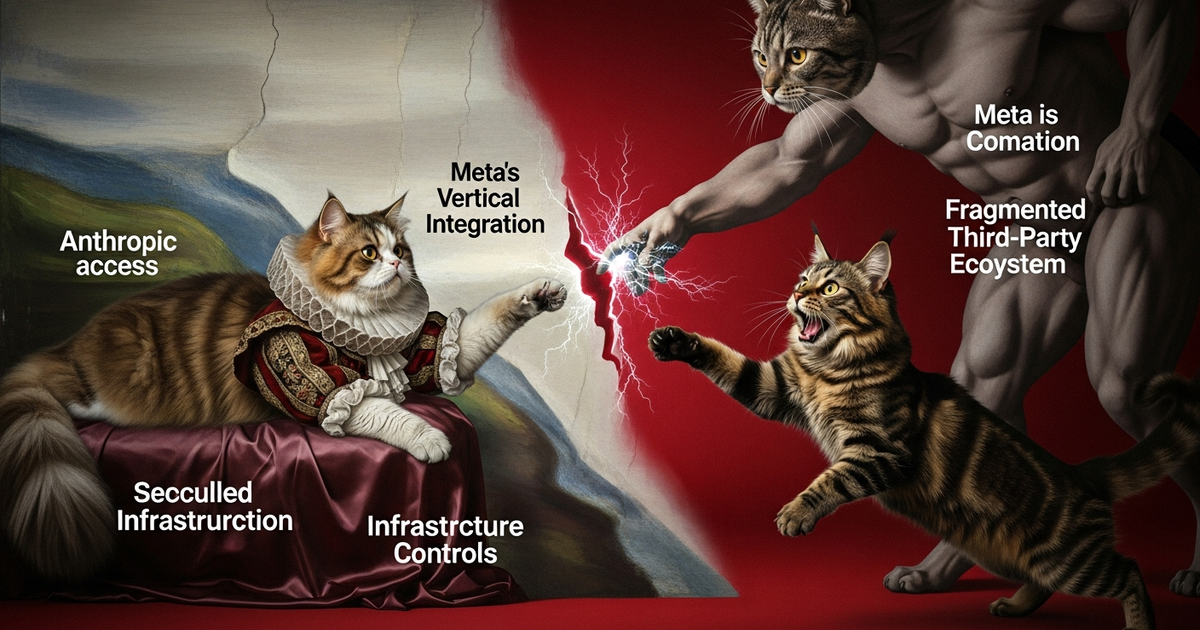
As of April 5, 2026, the AI industry is transitioning from a phase of rapid large model releases to optimizing operations, ensuring safety, and controlling ecosystems. Today was marked by notable strategic adjustments from various companies, including Anthropic’s restrictions on external tool access, Meta’s acceleration of vertical integration through the establishment of a hardware division, and Google’s research on evaluating LLM behavior.
2. Today’s Highlights
Anthropic Restricts Claude Access to Third-Party Tools
Anthropic has officially signaled its intent to restrict access to Claude via third-party agent tools for its subscribers. The company cited excessive load on Anthropic’s compute and engineering resources as the reason for this decision. This shift from an “open integration” stance to prioritizing resource management and quality assurance by moving towards a “closed environment” is a critical decision for model providers to protect their infrastructure amidst the rapid expansion of AI agent usage. Users are encouraged to utilize official APIs, and it is anticipated that access to models provided by companies will become more strictly managed. This change has sent significant shockwaves through the automation ecosystem, which was previously built on affordable subscriptions, forcing developers to transition to more costly API usage.
Source: Anthropic Official “Frontier Safety Roadmap Updates”
Meta Accelerates Vertical Integration by Building AI Hardware Division
Meta’s Superintelligence Lab (MSL) has established a dedicated hardware team, bringing in a former ByteDance executive as its leader. This signifies Meta’s evolution from a mere model development company to a “vertically integrated” entity that controls not only its AI applications but also the physical devices and infrastructure required to run them. The company has also been focusing on software efficiency, recently announcing “KernelEvolve,” an agent-based kernel generation system that dramatically improves model inference efficiency. This move into hardware aligns with CEO Mark Zuckerberg’s long-term strategy to make “AI smart glasses” the primary device for personal superintelligence, highlighting that model development and hardware optimization are inseparable challenges across the industry.
Source: Engineering at Meta “KernelEvolve”
3. Other News
-
Google Announces LLM Behavioral Evaluation Method Google Research has released a new evaluation framework for measuring how LLMs align with human social expectations and consensus. By analyzing LLM behavior in uncertain situations, it provides guidelines for future model alignment improvements. Source: Google Research Blog
-
OpenAI Acquires Media Network TBPN OpenAI has acquired TBPN, a producer of tech podcasts. The move aims to deepen constructive dialogue about the impact and changes in AI technology, representing a strategic content investment intended to establish the company as a “voice” for the industry. Source: OpenAI Company News
-
NVIDIA Emphasizes the Forefront of Physical AI Research In conjunction with National Robotics Week, NVIDIA has compiled the latest trends in research and hardware for AI models functioning in the physical world. Notably, technologies accelerating on-device agent operation using the Gemma 4 model were showcased. Source: NVIDIA Blog
-
Microsoft AI Continues Releasing Proprietary Models Microsoft is strengthening its internal stack while reducing its reliance on OpenAI by expanding its proprietary speech and language models, such as MAI-Transcribe-1. It particularly emphasizes its inference capabilities at low GPU costs. Source: Microsoft Research
-
Shift Towards “Intent-Based Engineering” in the AI Industry The utilization of AI is shifting from simple prompt input to “intent-based engineering,” where users define an “ideal state” and have AI execute it. The trend of emphasizing verifiability of results (Hill-climbing) is accelerating. Source: Daniel Miessler “The Most Important Ideas in AI Right Now”
4. Conclusion and Outlook
Today’s news strongly suggests that AI development is shifting its focus from “pursuit of performance” to “rationalization and control of operations.” Anthropic’s access restrictions and Meta’s vertical integration indicate that the battle for “infrastructure control” is intensifying, revolving around the environment and efficiency with which models operate, rather than the models themselves. In the future, the ability to safely and efficiently integrate with a company’s own hardware and systems will become a crucial determinant of competitive strength, even more so than individual model scores.
5. References
| Title | Source | Date | URL |
|---|---|---|---|
| Frontier Safety Roadmap Updates | Anthropic Blog | 2026-04-04 | https://www.anthropic.com/news/frontier-safety-roadmap-updates |
| KernelEvolve: How Meta’s Ranking Engineer Agent Optimizes AI Infrastructure | Engineering at Meta | 2026-04-02 | https://fb.com/engineering/2026/04/02/kernelevolve |
| Evaluating alignment of behavioral dispositions in LLMs | Google Research | 2026-04-03 | https://research.google.com/blog/evaluating-alignment-of-behavioral-dispositions-in-llms/ |
| OpenAI acquires TBPN | OpenAI Blog | 2026-04-02 | https://openai.com/index/openai-acquires-tbpn/ |
| National Robotics Week — Latest Physical AI Research, Breakthroughs and Resources | NVIDIA Blog | 2026-04-04 | https://nvidia.com/en-us/blog/national-robotics-week-latest-physical-ai-research-breakthroughs-and-resources/ |
This article was automatically generated by LLM. It may contain errors.